> ## Documentation Index
> Fetch the complete documentation index at: https://university.triggr-app.com/llms.txt
> Use this file to discover all available pages before exploring further.
# Cisco Meraki
> Connect your Cisco Meraki dashboard to Triggr with a Meraki administrator's dashboard API key.
Triggr manages Meraki organisations, networks, devices, wireless SSIDs, MX security appliances, switch ports and clients.
## Set up Cisco Meraki
The key has exactly the access of the administrator who generates it, and that administrator must sign in with a Meraki password, not SAML single sign-on.
In each organisation Triggr should work with, go to **Organization > Configure > Administrators** and click Add admin. Enter a Name such as `Triggr` and a mailbox you control, set Organization Access to Full (or Read-only if workflows only read data), click Create admin, then Save changes.
Set the administrator's password from Meraki's email and sign in as them. Click the avatar in the top right to open My Profile, click Generate API key under API access and copy the key. Meraki shows it only once.
If an organisation uses Login IP ranges (**Organization > Configure > Settings**), add [Triggr's IP addresses](/security/ip-allowlist) to its API ranges, and to its dashboard ranges too if you've set both.
See Meraki's [Cisco Meraki Dashboard API](https://documentation.meraki.com/General_Administration/Other_Topics/Cisco_Meraki_Dashboard_API) guide.
## Connect it in Triggr
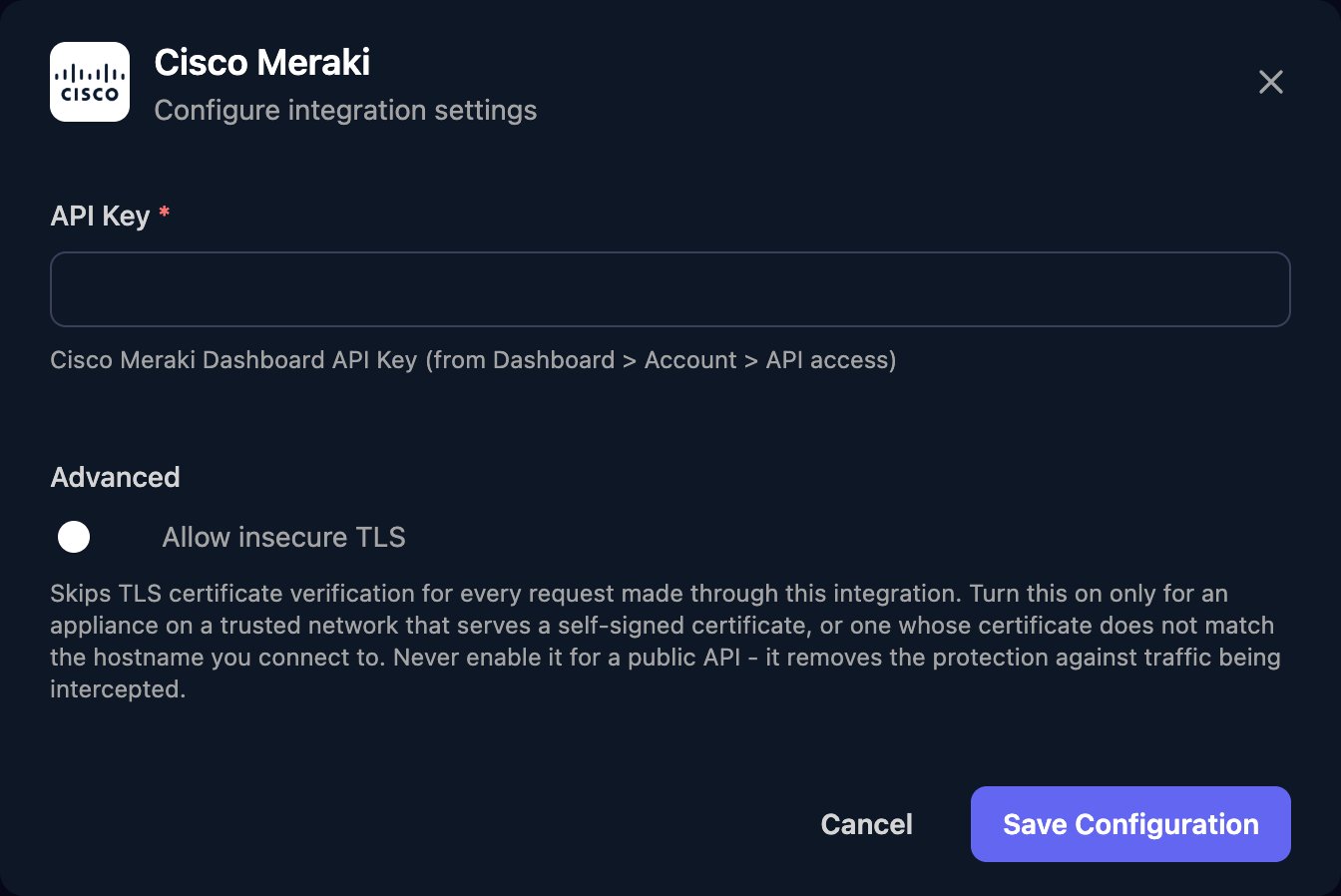
Go to **Integrations > Cisco Meraki** and click **Configure** on the Base Configuration card.
 Paste it into API Key, without `Bearer` in front, and click **Save Configuration**.
 One key covers every organisation its administrator can access, with no client mapping. Each step takes the `organizationId`, `networkId` or device `serial` it acts on; List Organizations returns the organisations the key can reach.
To replace the key, generate a new one in My Profile, paste it in via Edit on the Base Configuration card, then revoke the old one. Each administrator can have two keys at a time.
## Troubleshooting
Meraki returns 404 for a missing or wrong key. Check it was pasted in full, without `Bearer`, and hasn't been revoked. If only some actions fail, check the step's IDs.
The administrator has Read-only access in that organisation. Change its Organization Access to Full.
Add the Triggr administrator to that organisation, and check its Login IP ranges include [Triggr's IP addresses](/security/ip-allowlist). List Organizations ignores those ranges, so the organisation can appear there while other requests to it fail.
The account signs in through SAML. Use an administrator that signs in with a Meraki password.
This documentation is built and hosted on [Mintlify](https://mintlify.com), a developer documentation platform.
One key covers every organisation its administrator can access, with no client mapping. Each step takes the `organizationId`, `networkId` or device `serial` it acts on; List Organizations returns the organisations the key can reach.
To replace the key, generate a new one in My Profile, paste it in via Edit on the Base Configuration card, then revoke the old one. Each administrator can have two keys at a time.
## Troubleshooting
Meraki returns 404 for a missing or wrong key. Check it was pasted in full, without `Bearer`, and hasn't been revoked. If only some actions fail, check the step's IDs.
The administrator has Read-only access in that organisation. Change its Organization Access to Full.
Add the Triggr administrator to that organisation, and check its Login IP ranges include [Triggr's IP addresses](/security/ip-allowlist). List Organizations ignores those ranges, so the organisation can appear there while other requests to it fail.
The account signs in through SAML. Use an administrator that signs in with a Meraki password.
This documentation is built and hosted on [Mintlify](https://mintlify.com), a developer documentation platform.