> ## Documentation Index
> Fetch the complete documentation index at: https://university.triggr-app.com/llms.txt
> Use this file to discover all available pages before exploring further.
# Clients and variables
> Add the businesses you support, store each one's IDs and settings as variables, and set your organisation's defaults.
Each client carries variables, such as its Microsoft tenant ID or PSA client ID, that forms and workflows use to act for the right business.
 ## Add a client
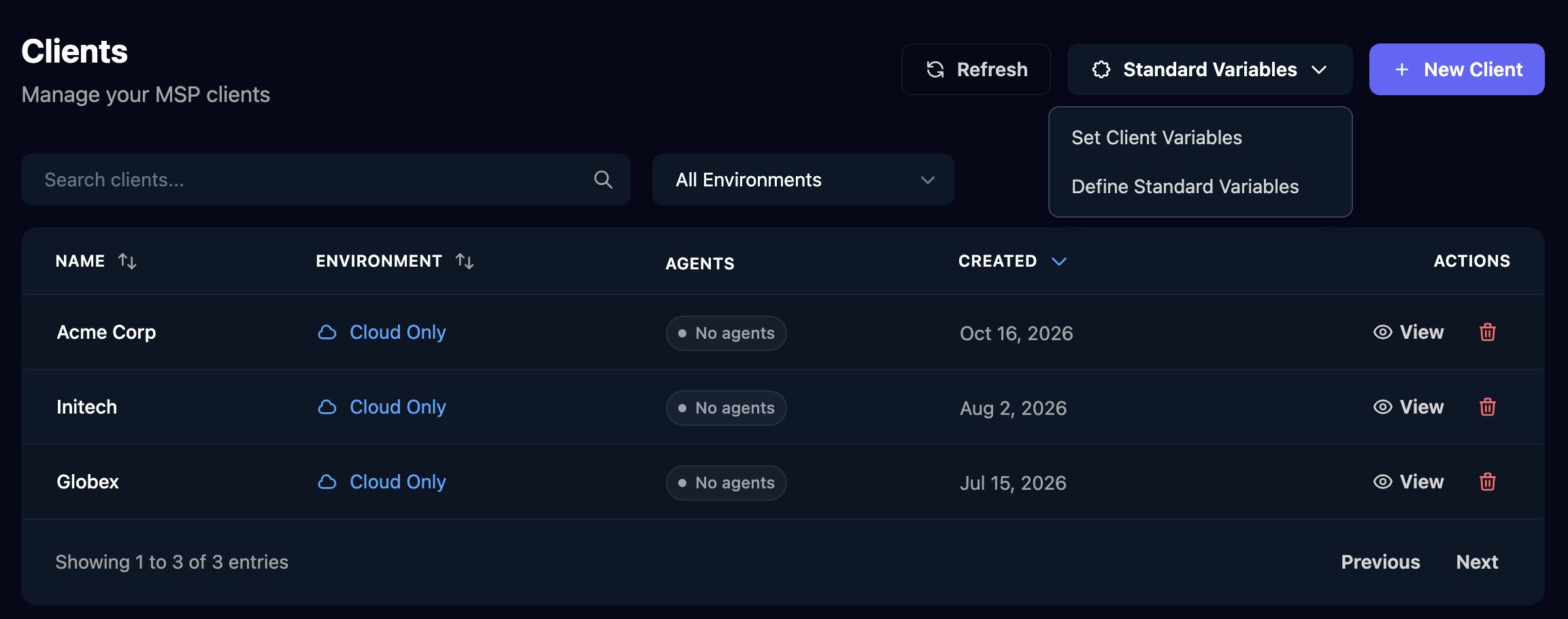
In Clients, click **New Client**, enter the name, choose the Environment and click **Create Client**.
## Add a client
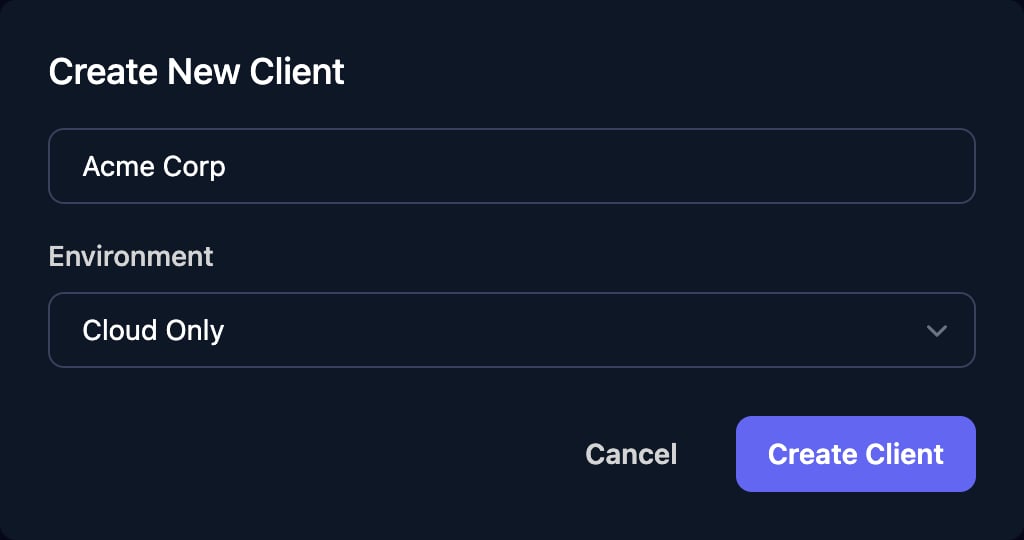
In Clients, click **New Client**, enter the name, choose the Environment and click **Create Client**.
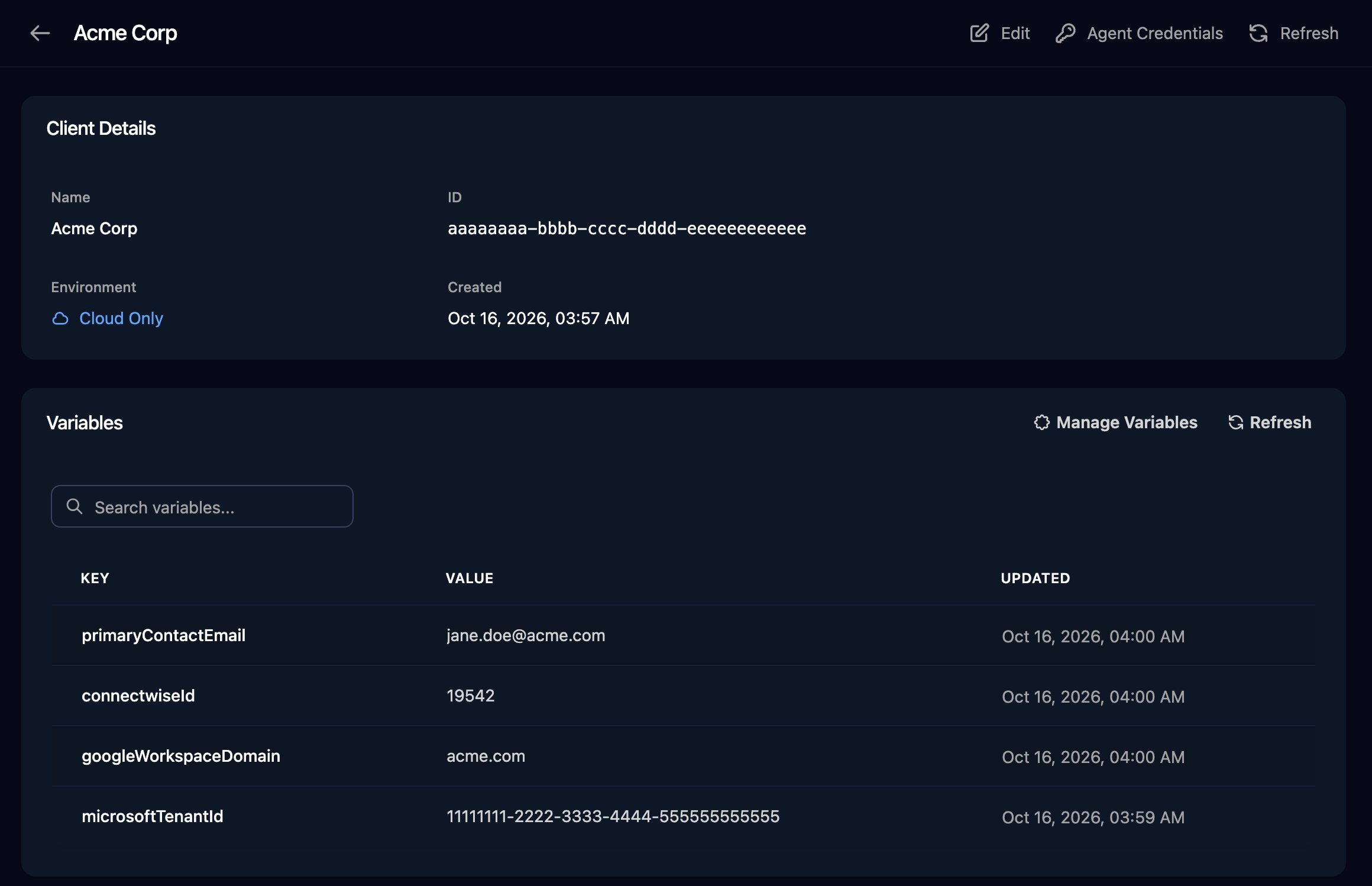
 Click **View** on its row. Edit changes the name or environment; Agent Credentials sets up the [desktop agent](/desktop-agent/generate-credentials).
 Choose **Cloud Only** for Microsoft 365-only clients; the other environments are for clients with on-premises Active Directory. Clients are shared with [Triggr Core](/core/get-started/add-your-clients), so clients added or imported there appear here too.
## Give it variables
Click **Manage Variables** on the client's Variables card.
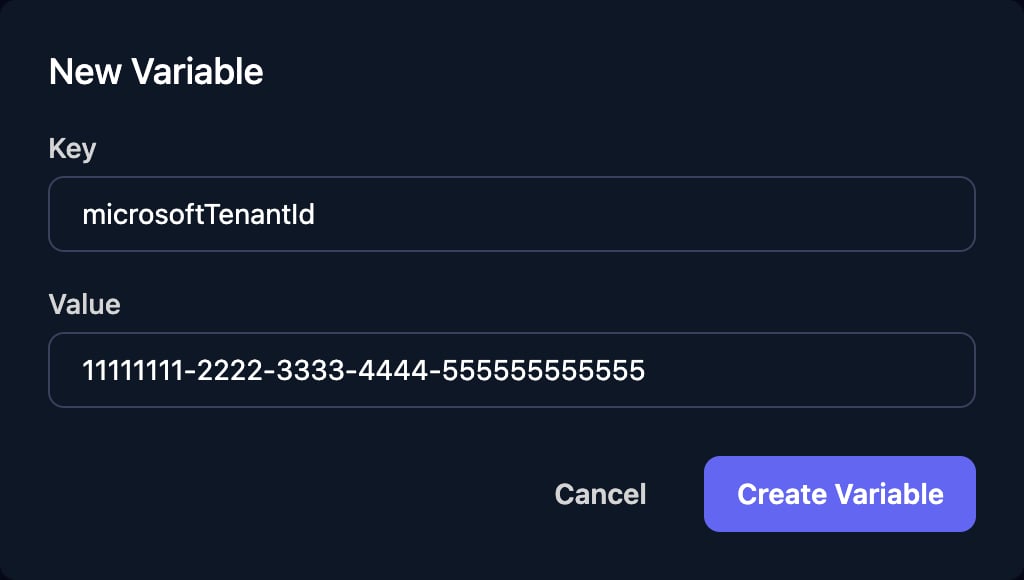
Click **New Variable**, enter the Key and Value, and click **Create Variable**.
Choose **Cloud Only** for Microsoft 365-only clients; the other environments are for clients with on-premises Active Directory. Clients are shared with [Triggr Core](/core/get-started/add-your-clients), so clients added or imported there appear here too.
## Give it variables
Click **Manage Variables** on the client's Variables card.
Click **New Variable**, enter the Key and Value, and click **Create Variable**.
 Click **Set Value** on any [standard variable](#standard-variables) marked Not Set.
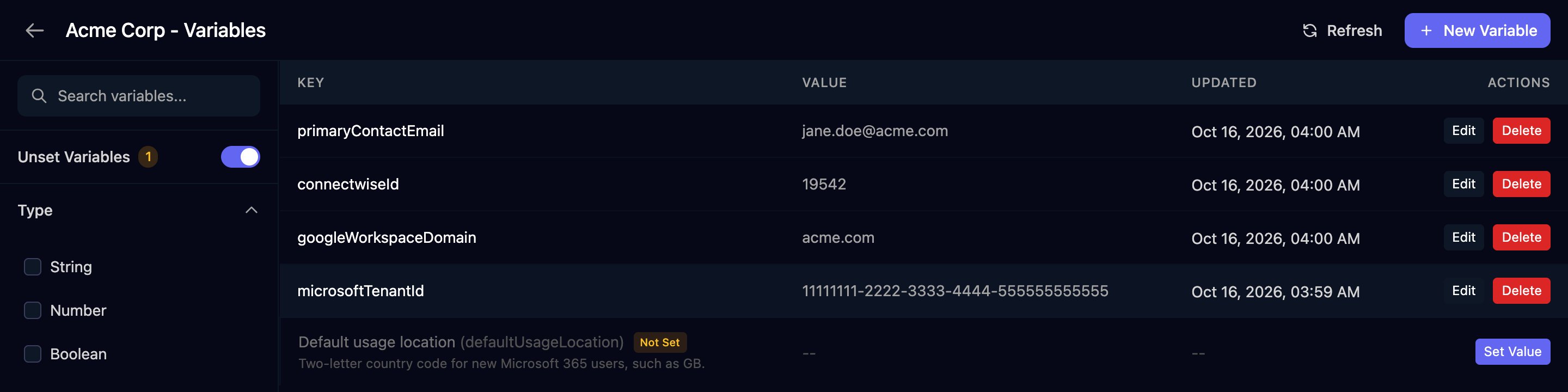 Keys are case-sensitive: `microsoftTenantId` works, `MicrosoftTenantID` doesn't. A value that's a number, `true`, `false` or JSON reaches workflows as that type; anything else is text.
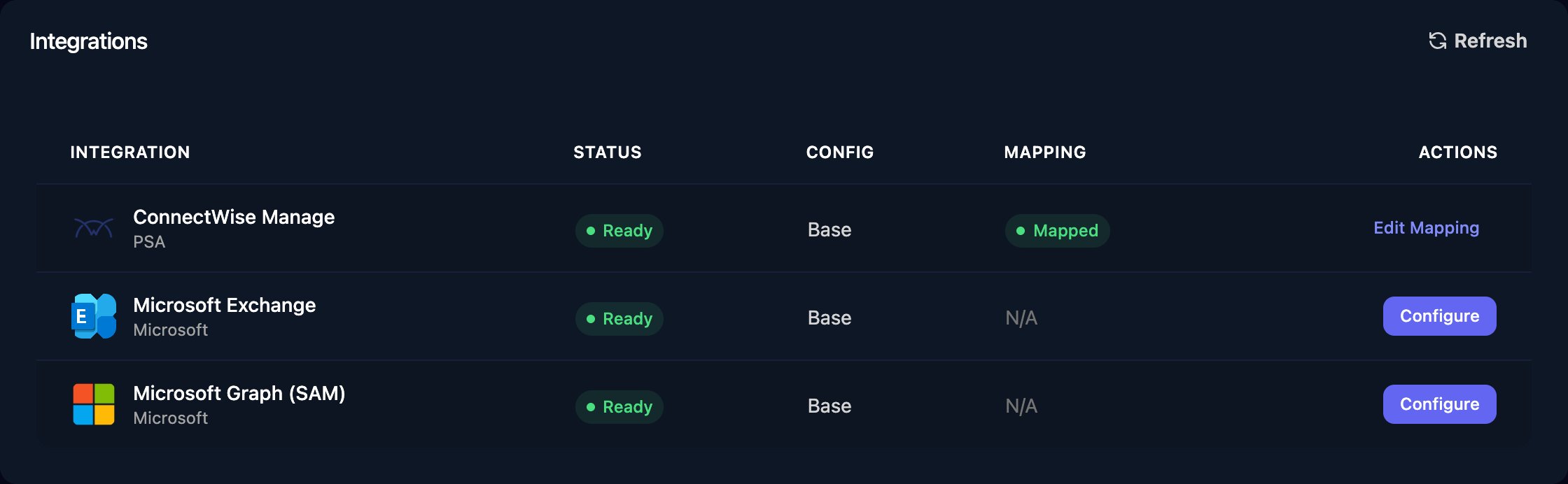
Integration IDs come from mapping instead: map clients on an integration's Client Mapping card, or click Map or Edit Mapping on the client's Integrations card, and Triggr saves each match as a variable.
Keys are case-sensitive: `microsoftTenantId` works, `MicrosoftTenantID` doesn't. A value that's a number, `true`, `false` or JSON reaches workflows as that type; anything else is text.
Integration IDs come from mapping instead: map clients on an integration's Client Mapping card, or click Map or Edit Mapping on the client's Integrations card, and Triggr saves each match as a variable.
 ## Variables Triggr uses
| Variable | Set by | Used by |
| - | - | - |
| `microsoftTenantId` | [Microsoft Graph (GDAP)](/integrations/microsoft-graph/gdap-service-account) linking, Per-Client Configuration for [Microsoft Graph (SAM)](/integrations/microsoft-graph/sam) or [Defender for Endpoint](/integrations/microsoft-defender-endpoint), Triggr Core, or by hand | [Microsoft sign-in](/studio/forms/authentication) on forms and apps, Set Client From Form, [CIPP](/integrations/cipp) steps |
| `microsoftTenantDomain` | GDAP linking, or [Microsoft Exchange](/integrations/microsoft-exchange)'s Per-Client Configuration | Microsoft Exchange steps |
| `googleWorkspaceDomain` | By hand; separate several domains with commas | [Google sign-in](/studio/forms/authentication) on forms and apps |
| `haloId`, `connectwiseId`, `autotaskId` | Client Mapping for [HaloPSA](/integrations/halopsa), [ConnectWise PSA](/integrations/connectwise-psa) or [Autotask](/integrations/autotask) | Create Ticket when its client ID is blank |
| `pax8Id`, `sherwebId`, `tdSynnexId` | Client Mapping for [Pax8](/integrations/pax8), [Sherweb](/integrations/sherweb) or [TD SYNNEX Stellr](/integrations/td-synnex/stellr), or linking in Core | Core's [automatic seat purchase](/core/manage/licences-and-distributors#buy-seats-automatically) |
Other Client Mapping cards save an ID for your workflows to pass into that integration's actions: `autoElevateCompanyId`, `auvikTenantId`, `dattoBcdrOrganizationId`, `dattoSaasProtectionId`, `dattoSiteId` and `dattoSiteUid`, `duoAccountId`, `fieldEffectOrganizationId`, `hubspotId`, `huduId`, `huntressId`, `itGlueId`, `ncentralCustomerId`, `ninjaId`, `organizationId` (DNSFilter), `sentinelOneSiteId` and `syncroId`. Each integration's guide says which actions take it.
## Use variables in a workflow
Once a [Client step](/studio/workflows/steps#client) such as Set Client From Form has run, `ctx.client` holds the client's `id`, `name`, `environment` and every variable; org variables are in `ctx.org`:
```text theme={null}
{{ ctx.client.name }} Acme Corp
{{ ctx.client.microsoftTenantId }} 11111111-2222-3333-4444-555555555555
{{ ctx.client.primaryContactEmail }} jane.doe@acme.com
{{ ctx.org.defaultPSA }} halo
```
`environment` is `cloudOnly`, `onPremOnly`, `cloudAndOnPremSeparate` or `cloudAndOnPremSynced`. A client mapped to several external clients has the first ID in `haloId`, all of them in `haloIdList` and a comma-separated list in `haloIdCsv`; the same goes for every mapping. See [Expressions](/studio/workflows/expressions) for everything else a template can read.
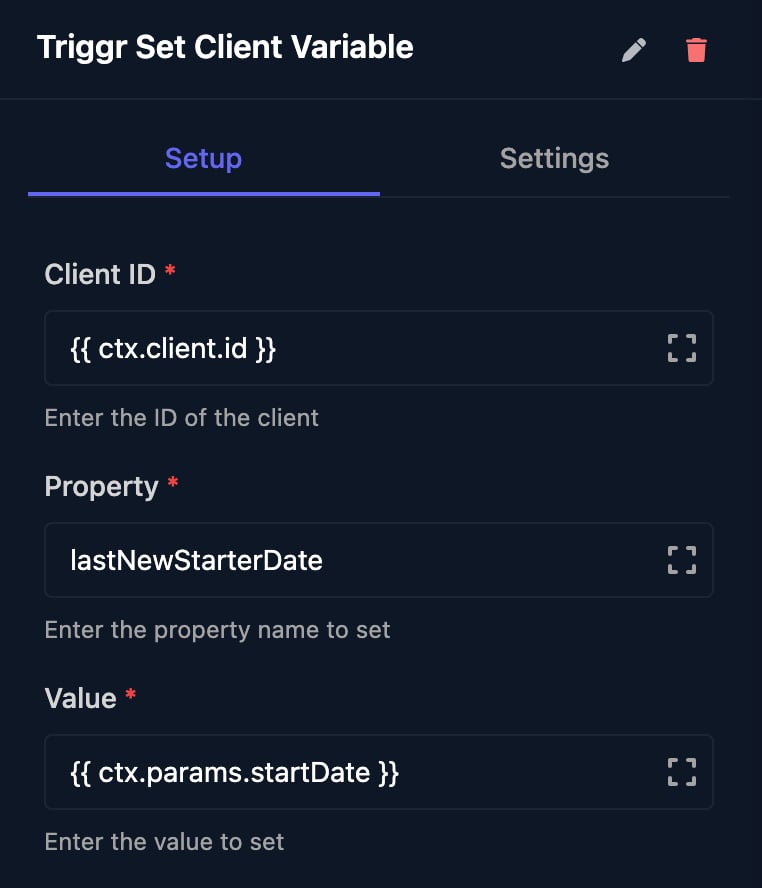
To save a value back, add the Triggr group's **Set Client Variable** step with **Client ID** `{{ ctx.client.id }}`. An empty Value deletes the variable.
## Variables Triggr uses
| Variable | Set by | Used by |
| - | - | - |
| `microsoftTenantId` | [Microsoft Graph (GDAP)](/integrations/microsoft-graph/gdap-service-account) linking, Per-Client Configuration for [Microsoft Graph (SAM)](/integrations/microsoft-graph/sam) or [Defender for Endpoint](/integrations/microsoft-defender-endpoint), Triggr Core, or by hand | [Microsoft sign-in](/studio/forms/authentication) on forms and apps, Set Client From Form, [CIPP](/integrations/cipp) steps |
| `microsoftTenantDomain` | GDAP linking, or [Microsoft Exchange](/integrations/microsoft-exchange)'s Per-Client Configuration | Microsoft Exchange steps |
| `googleWorkspaceDomain` | By hand; separate several domains with commas | [Google sign-in](/studio/forms/authentication) on forms and apps |
| `haloId`, `connectwiseId`, `autotaskId` | Client Mapping for [HaloPSA](/integrations/halopsa), [ConnectWise PSA](/integrations/connectwise-psa) or [Autotask](/integrations/autotask) | Create Ticket when its client ID is blank |
| `pax8Id`, `sherwebId`, `tdSynnexId` | Client Mapping for [Pax8](/integrations/pax8), [Sherweb](/integrations/sherweb) or [TD SYNNEX Stellr](/integrations/td-synnex/stellr), or linking in Core | Core's [automatic seat purchase](/core/manage/licences-and-distributors#buy-seats-automatically) |
Other Client Mapping cards save an ID for your workflows to pass into that integration's actions: `autoElevateCompanyId`, `auvikTenantId`, `dattoBcdrOrganizationId`, `dattoSaasProtectionId`, `dattoSiteId` and `dattoSiteUid`, `duoAccountId`, `fieldEffectOrganizationId`, `hubspotId`, `huduId`, `huntressId`, `itGlueId`, `ncentralCustomerId`, `ninjaId`, `organizationId` (DNSFilter), `sentinelOneSiteId` and `syncroId`. Each integration's guide says which actions take it.
## Use variables in a workflow
Once a [Client step](/studio/workflows/steps#client) such as Set Client From Form has run, `ctx.client` holds the client's `id`, `name`, `environment` and every variable; org variables are in `ctx.org`:
```text theme={null}
{{ ctx.client.name }} Acme Corp
{{ ctx.client.microsoftTenantId }} 11111111-2222-3333-4444-555555555555
{{ ctx.client.primaryContactEmail }} jane.doe@acme.com
{{ ctx.org.defaultPSA }} halo
```
`environment` is `cloudOnly`, `onPremOnly`, `cloudAndOnPremSeparate` or `cloudAndOnPremSynced`. A client mapped to several external clients has the first ID in `haloId`, all of them in `haloIdList` and a comma-separated list in `haloIdCsv`; the same goes for every mapping. See [Expressions](/studio/workflows/expressions) for everything else a template can read.
To save a value back, add the Triggr group's **Set Client Variable** step with **Client ID** `{{ ctx.client.id }}`. An empty Value deletes the variable.
 To find a client from an ID another system sends, use **Search For Client** with Property Variable (see [Steps](/studio/workflows/steps#client)).
## Standard variables
Standard variables are the checklist of variables every client should have. They don't hold values: a client without one shows Not Set, and a template that reads it fails with “Missing or invalid variable”.
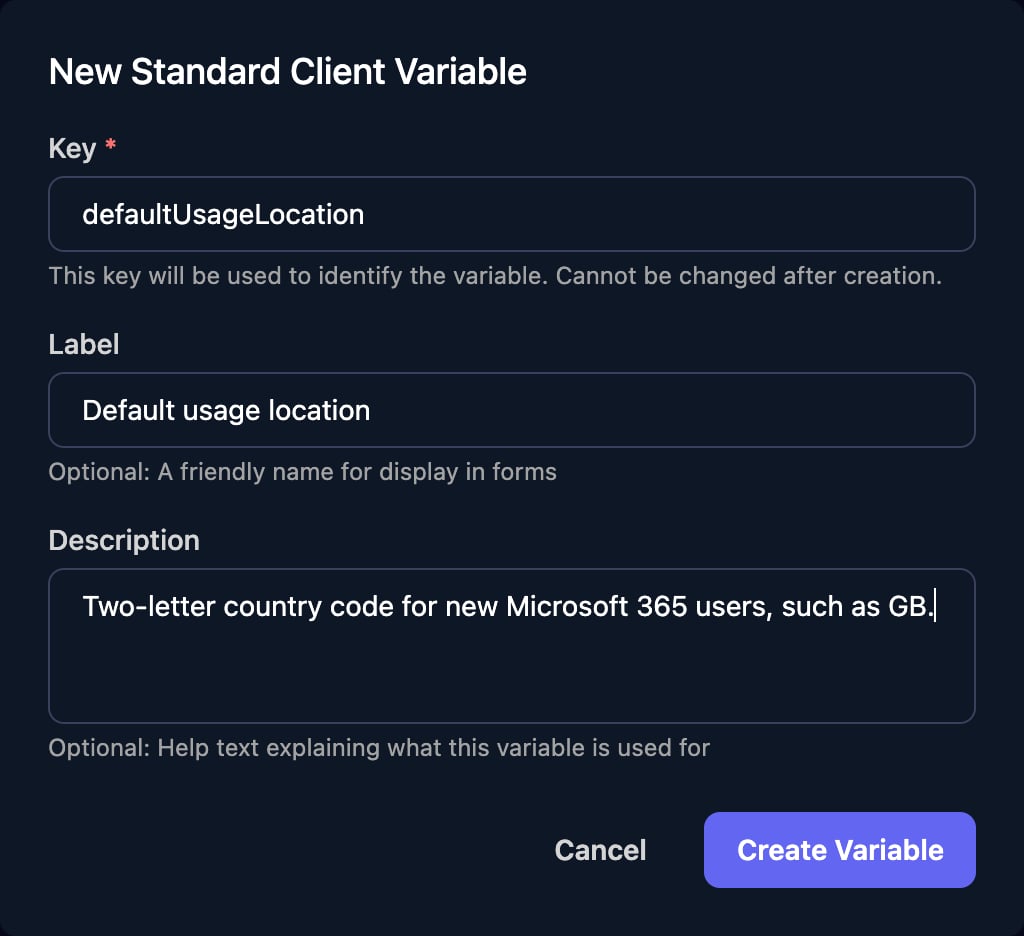
In Clients, click **Standard Variables > Define Standard Variables**, then **New Variable**. Enter the Key, Label and Description, and click **Create Variable**.
To find a client from an ID another system sends, use **Search For Client** with Property Variable (see [Steps](/studio/workflows/steps#client)).
## Standard variables
Standard variables are the checklist of variables every client should have. They don't hold values: a client without one shows Not Set, and a template that reads it fails with “Missing or invalid variable”.
In Clients, click **Standard Variables > Define Standard Variables**, then **New Variable**. Enter the Key, Label and Description, and click **Create Variable**.
 Click **Standard Variables > Set Client Variables**. Type in a cell and press Enter to save; Esc cancels.
 ## Org variables
Org variables apply to your whole organisation. Find them in **Settings > Org Variables**; workflows read them as `ctx.org.`, and form fields can show or hide on them.
## Org variables
Org variables apply to your whole organisation. Find them in **Settings > Org Variables**; workflows read them as `ctx.org.`, and form fields can show or hide on them.
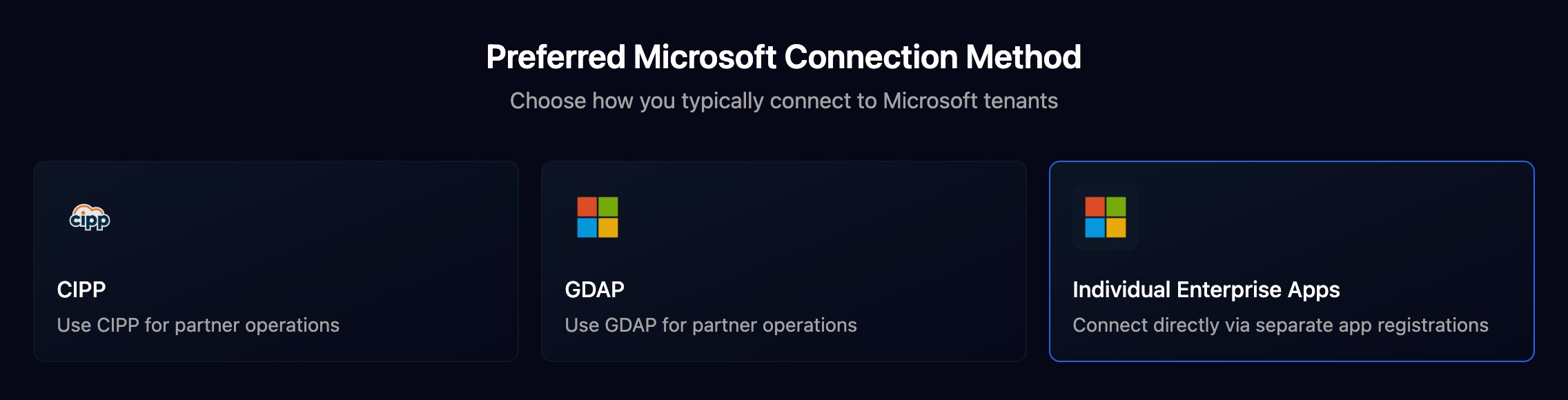
 Setup Wizard sets the two that steps rely on. Each choice saves as soon as you click it.
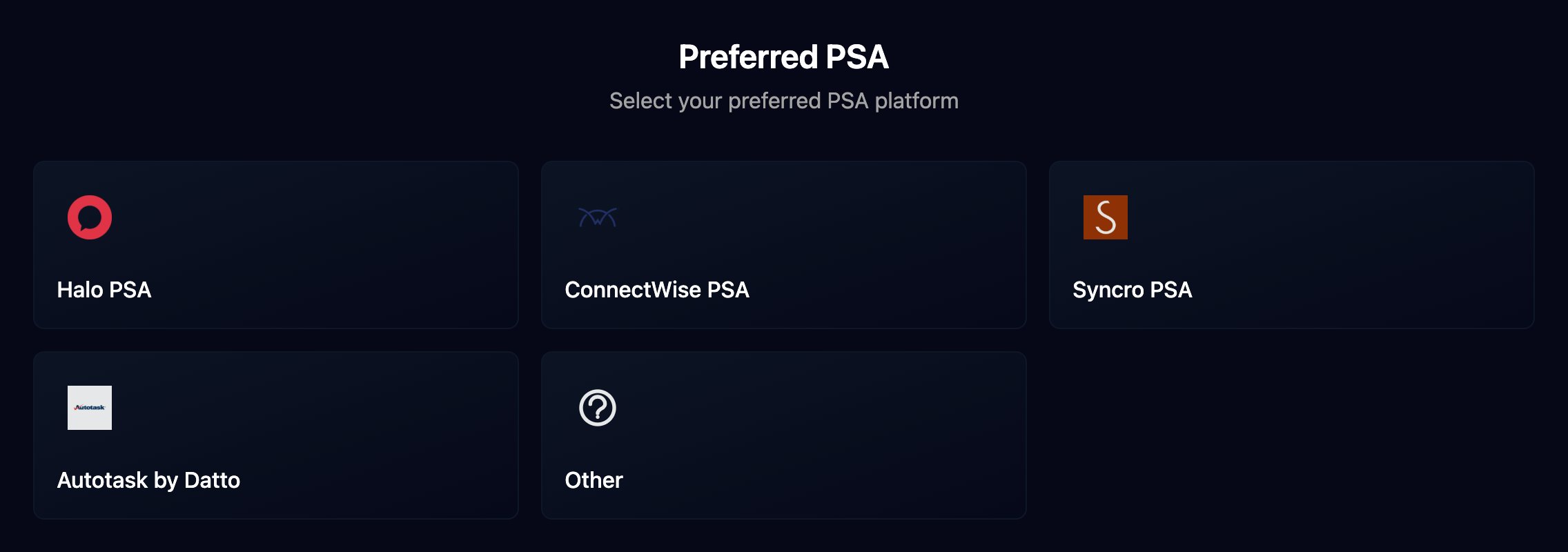
 Pick your PSA and click **Finish**.
 | Choice | Saves | What it does |
| - | - | - |
| CIPP, GDAP or Individual Enterprise Apps | `defaultMicrosoftConnection`: `CIPP`, `microsoftGDAP` or `microsoftSAM` | Microsoft steps with Connection Type Automatic, and Microsoft dropdowns on forms, connect through [CIPP](/integrations/cipp), [Microsoft Graph (GDAP)](/integrations/microsoft-graph/gdap-service-account) or [Microsoft Graph (SAM)](/integrations/microsoft-graph/sam) |
| A PSA | `defaultPSA`: `halo`, `connectwise`, `autotask`, `syncro` or `other` | Create Ticket and Log to Ticket raise and update tickets in it (Halo PSA, ConnectWise PSA and Autotask by Datto) |
Triggr Core's PSA and Microsoft settings save the same two variables, so changing them in either app changes both.
## FAQ
The client may already have a variable with that key. Click Edit on its row instead.
Create Ticket needs `defaultPSA` set to `halo`, `connectwise` or `autotask`. Run Setup Wizard and pick your PSA.
Run Setup Wizard and choose a Microsoft connection method, or set the step's Connection Type.
The run's client has no `microsoftTenantId`. Add it on Manage Variables.
`ctx.client` is read when the run sets its client, so changes apply from the next run, including values written by Set Client Variable earlier in the same run.
They need the Admin role. See [Team and permissions](/studio/clients/team-and-permissions).
This documentation is built and hosted on [Mintlify](https://mintlify.com), a developer documentation platform.
| Choice | Saves | What it does |
| - | - | - |
| CIPP, GDAP or Individual Enterprise Apps | `defaultMicrosoftConnection`: `CIPP`, `microsoftGDAP` or `microsoftSAM` | Microsoft steps with Connection Type Automatic, and Microsoft dropdowns on forms, connect through [CIPP](/integrations/cipp), [Microsoft Graph (GDAP)](/integrations/microsoft-graph/gdap-service-account) or [Microsoft Graph (SAM)](/integrations/microsoft-graph/sam) |
| A PSA | `defaultPSA`: `halo`, `connectwise`, `autotask`, `syncro` or `other` | Create Ticket and Log to Ticket raise and update tickets in it (Halo PSA, ConnectWise PSA and Autotask by Datto) |
Triggr Core's PSA and Microsoft settings save the same two variables, so changing them in either app changes both.
## FAQ
The client may already have a variable with that key. Click Edit on its row instead.
Create Ticket needs `defaultPSA` set to `halo`, `connectwise` or `autotask`. Run Setup Wizard and pick your PSA.
Run Setup Wizard and choose a Microsoft connection method, or set the step's Connection Type.
The run's client has no `microsoftTenantId`. Add it on Manage Variables.
`ctx.client` is read when the run sets its client, so changes apply from the next run, including values written by Set Client Variable earlier in the same run.
They need the Admin role. See [Team and permissions](/studio/clients/team-and-permissions).
This documentation is built and hosted on [Mintlify](https://mintlify.com), a developer documentation platform.