

Set up FortiManager
- REST API key (recommended)
- Username and password
Needs FortiManager 7.2.2 or later.
- In System Settings > Administrators (System Settings > Admin > Administrators on 7.2), select Create New > REST API Admin.
- Set Admin Profile (Super_User covers every action) and JSON API Access to Read-Write, or Read for read-only workflows.
- Add Triggr’s outbound IP addresses under Trusted Hosts, then click OK.
- Copy the API key. FortiManager shows it only once; to replace it, click Regenerate API Key.
Connect it in Triggr
1
Open the integration
Go to Integrations > FortiManager and click Configure on the Base Configuration card.
2
Enter the URL and credentials
Enter the FortiManager URL, such as 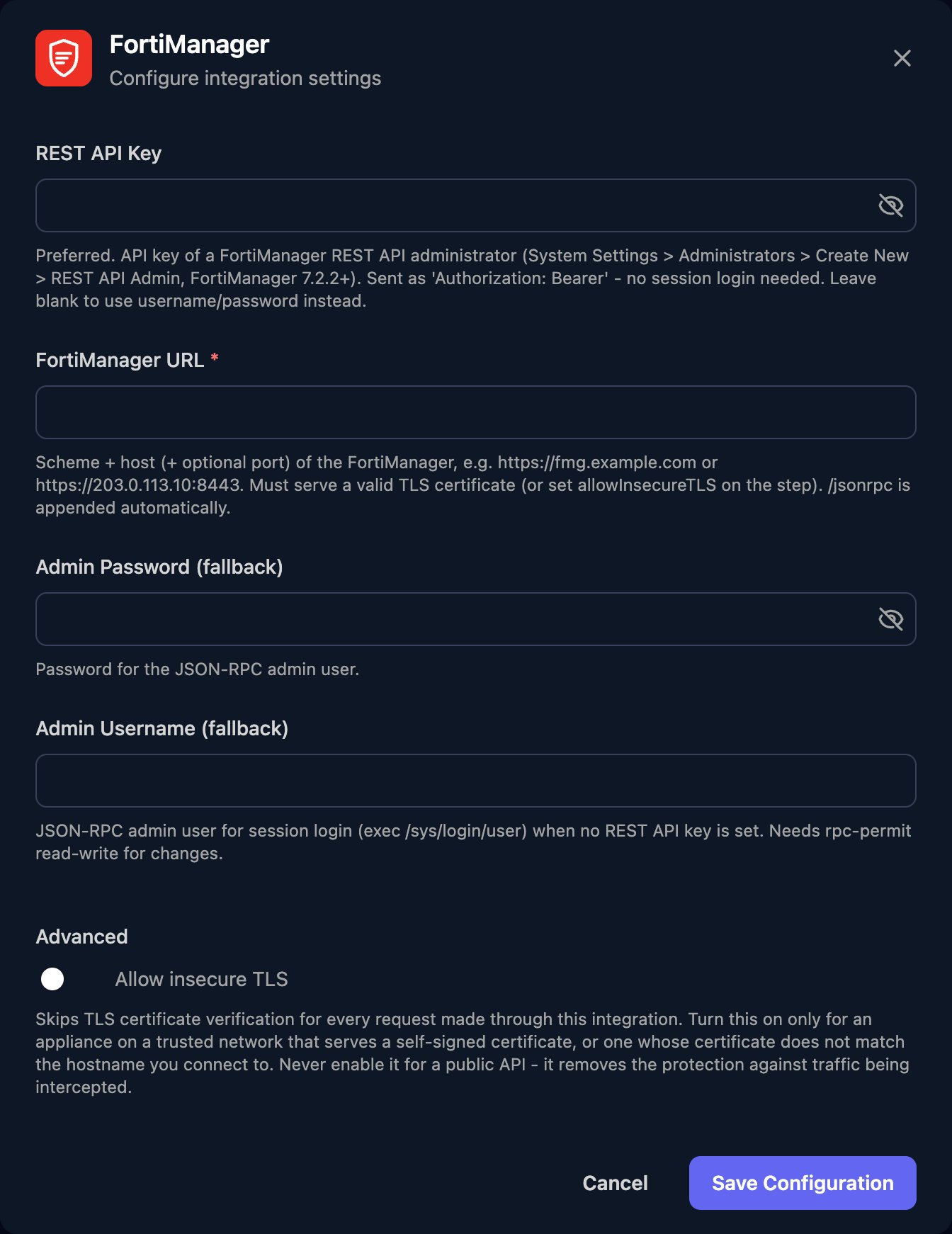
https://fmg.example.com, with the port if it isn’t 443 and no /jsonrpc (include a reverse proxy’s path if you use one). Enter either the REST API Key, or the Admin Username (fallback) and Admin Password (fallback); if a key is set, Triggr uses it. With a key and a self-signed certificate, turn on Allow insecure TLS. Click Save Configuration.adom (from List ADOMs, or root without ADOMs), device and pkg. FortiManager often reports errors with HTTP 200, so check result[0].status in the step’s output.
Troubleshooting
configure a REST API key (apiToken) or an admin username and password
configure a REST API key (apiToken) or an admin username and password
The configuration has no REST API Key and is missing the username or password. Enter a key, or both fallback fields.
login failed
login failed
Check the username, password, JSON API Access and trusted hosts. If it mentions a certificate, install a trusted one or switch to a REST API key with Allow insecure TLS.
Authentication errors with a REST API key
Authentication errors with a REST API key
Check the key is complete and current, Trusted Hosts includes every Triggr IP address, and FortiManager runs 7.2.2 or later.
Changes are refused
Changes are refused
For “No permission for the resource” (code -11), set JSON API Access to Read-Write and check the Admin Profile and ADOM access. With workspace mode on, FortiManager only accepts Policy & Objects changes while the ADOM is locked.
Connection fails or times out
Connection fails or times out
Check the URL is the public address with
https:// and the right port, HTTPS is allowed on the interface, nothing blocks Triggr’s IP addresses, and the hostname doesn’t resolve to a private address.Monitor Device actions fail
Monitor Device actions fail
They read live from the FortiGate through FortiManager, so the device must be online and connected, with
adom and device matching List ADOM Devices.